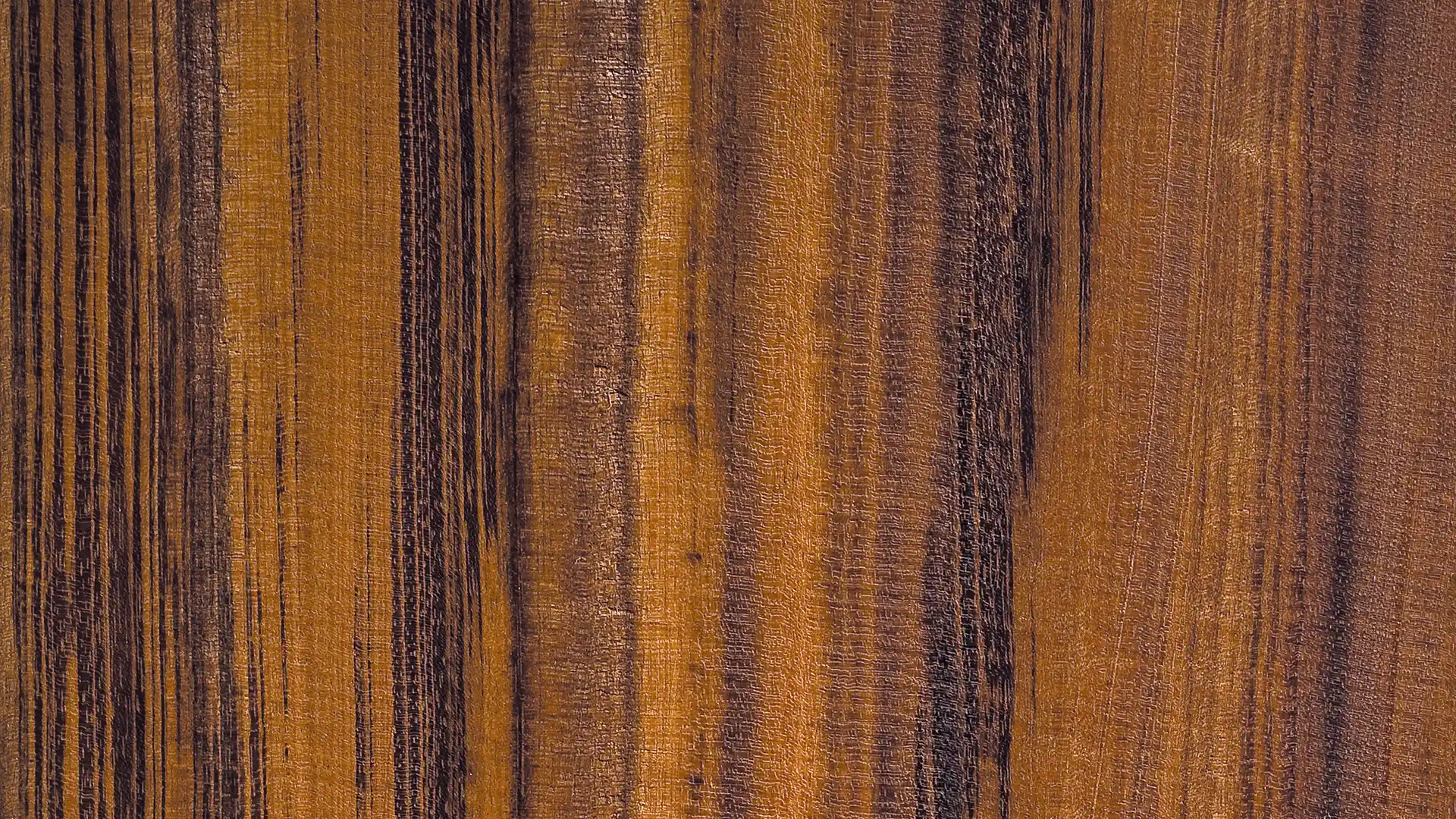
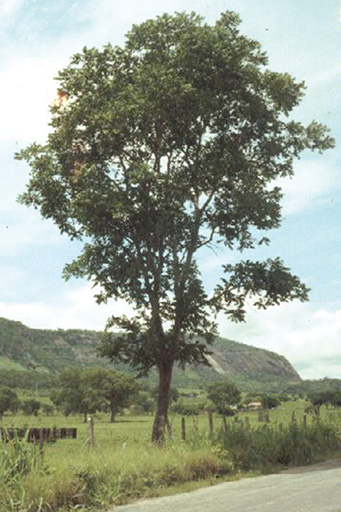
Astronium fraxinifolium

Specifications

Family
Anacardiaceae

Species
Astronium fraxinifolium Schott
kingwood
locustwood
zebrawood
Description
It is differentiated, with a thin yellowish-white sapwood and reddish or brown heartwood with darker variegations, medium texture, varied grain and a volumetric weight of 0.85 to 1.30.
Plant morphology

It is a tree 8 to 12 m tall, with an erect, cylindrical trunk 40-60 cm in diameter, grayish-black bark that peels, and a pyramidal crown. The leaves are pinnately compound, subcoriaceous, slightly pubescent, and vary in size. The inflorescence is a terminal raceme consisting of small yellow flowers. The fruit is an achene.

Natural occurrence

Countries of origin and distribution

Central Brazil, states of Goias, Mato Grosso, Minas Gerais.

Habitat and ecology

Deciduous, heliophilous and xerophilous species, it grows in very well-drained soils and is a pioneer in areas of secondary forest regrowth.

Uses

Use class
CU1
CU2
CU3
CU4
CU5
Application areas

Highly resistant to mechanical stress and highly durable, it is used for load-bearing structures, civil, road, hydraulic and naval constructions, and luxury furniture.

Threats and Conservation

Threats

Not reported.

Conservation measures

Not reported.

IUCN Red List IUCN

Not present.

CITES. Year of assessment CITES

CITES Italia • Ultimo aggiornamento

Not present.

Technical data


Aesthetic characteristics

Grain

Obvious

Texture

Fine


Physical and mechanical properties

Density
ρ
800 kg/m3
Radial shrinkage
Rad. sh.
43
MPa
Tangential shrinkage
Tang. sh.
79
MPa
Bending strength
M.O.R.
96 MPa
Modulus of Elasticity
M.O.E.
16500 MPa

Durability characteristics

Fungal resistance

Very durable

Insect resistance

Resistant