Aningeria spp.
Specifications
Family
Sapotaceae
Species
Aningeria spp.
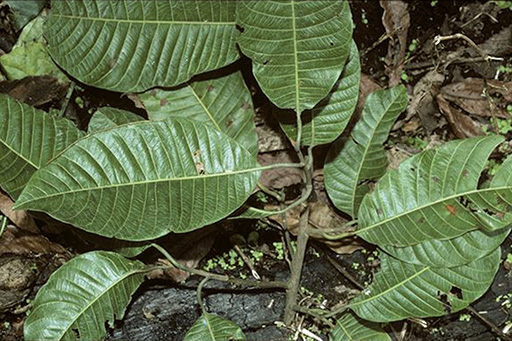

Large trees, up to 50 meters tall, have an erect, columnar trunk covered with smooth, grayish bark. The young branches and petioles are finely pubescent. The simple leaves have oblong-elliptical blades, a rounded base, and a pointed tip. The flowers, borne in axillary inflorescences, are scented with a cream-colored corolla characterized by pubescent petals. The fruit is red, subglobose, pubescent when young and glabrous when ripe.
Tropical Africa: Cameroon, Equatorial Guinea, Central African Republic, Sudan, Ethiopia, Kenya, Ivory Coast, Ghana, Uganda.
Species widespread from 1,000 to 1,700 m, in forest areas.
It is used in general carpentry, furniture, furnishings, plywood, veneers, turning, tools and various objects.
The main threat to the conservation of these species is excessive harvesting for commercial timber. In the case of Aningeria pierrei, another threat is fires; between 2001 and 2007, for example, 50% of this species' population was lost to fires (Lemmens, 2007).
Protected areas and ex situ conservation.
Aningeria altissima LC - Least Concern - A low risk (1998); A. adolphi-friederici LC - Least Concern - Low risk (2018); Aningeria pierrei LC - Least Concern - Low Risk (2019).
CITES Italia • Ultimo aggiornamento
Not present.
Not obvious
Fine
Not very durable
Not resistant
Aoname wood comes from the processing of some species belonging to the Aningera genus: A. altissima (A.Chev.) Aubrév. & Pellegr., A. adolphi-friederici Rob. & Gilb., A. pierrei (A.Chev.) Aubrév. & Pilgrim.